

Friday, July 6, 2012

Thursday, June 28, 2012

Wednesday, June 20, 2012

Tuesday, June 19, 2012


Tuesday, April 10, 2012
Books We Recommend


We are proud to announce the publication (in Romania) of Rashid's compendium “Common Mental Disorders of the Modern Age”. This amazing book is a best-seller in India, Japan, UK and USA. If you are considering a career in psychology, this would definitely be the book that you should go for! Mr. Sheik Urbooti will be taking part in a press conference and autograph session. He will be in Tîrgu Mureş Friday, 4th May.

Monday, December 26, 2011
Antisocial Personality Disorder (AsPD) – The Case of Napoleon, the Berkshire boar
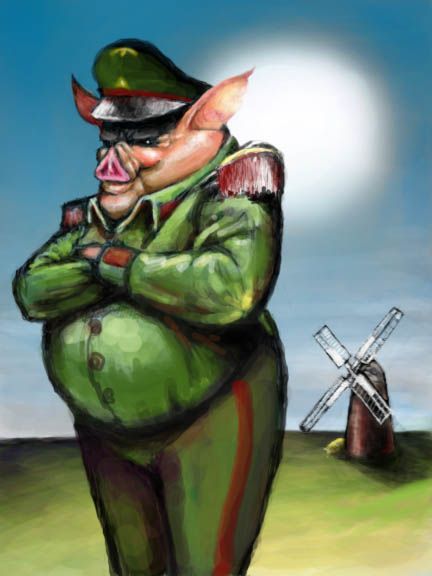
Napoleon is a large, rather fierce-looking Berkshire boar, not much of a talker, but with a reputation for getting his way. Acquaintances describe him as being treacherous and cunning. He grew up, within a very dysfunctional, abusive, and poor family. Due to having smallpox when he was younger, Napoleon was forever scarred and had a disfigured arm. Because of the feelings that life treated him unfairly, he came up with a reckless and amplified desire for power. Napoleon's mother sow had four piglets, three of which died and Napoleon's mother believed that her son's health was in jeopardy. Napoleon always felt inferior to educated intellectuals, and in particular distrusted them.
We get indication of Napoleon's antisocial nature long before it bursts into full force. He begins by unleashing the dogs on Snowball. Next he crushes the hen rebellion by suspending their food rations, causing the demise of a considerable number of hens. Napoleon exterminates anyone that had the power to contradict him. Whenever there was a road block in his radical road to success, Napoleon destroyed it, not minding if it was a friend or foe….
Sheik Urbooti Rashid, Ph.D. mentions that the main characteristic of a sociopath is a disregard for the rights of others. Also, sociopaths find it hard to sustain relationships and show a lack of regret in their actions. Napoleon has little apparent empathy for the feelings and desires of others, though he is capable of exhibiting a great deal of superficial charm in order to manipulate other animals into getting what he wants. Napoleon is suffering from a number of psychiatric symptoms that fit the diagnosis of Antisocial Personality Disorder (violent tendencies, grandiose sense of self-worth, criminal versatility, reckless disregard for the safety of self or others, irresponsibility, deceitfulness/ manipulativeness)…
As expected, Napoleon refused our help and continued with his career as a ruthless dictator…
Wednesday, November 23, 2011
Dr. Rashid psychological point of view of Dorian Gray
Mental illness is obviously a widely approached topic in Victorian studies, simply because there are so many texts that address it – Charlotte Brontë’s Jane Eyre, Mary Elizabeth Braddon’s Lady Audley’s Secret, Oscar Wilde’s The Picture of Dorian Gray.
A. Case History
Dorian Gray is a good looking young man who inherits his uncle's fortune. After his uncle's death, he moves from a small village into the defunct estate. His life changes radically, from being poor to being rich, from being moral to being corrupt. His new friends are Basil Hallward (the artist who is impressed by Dorian's beauty and consider him suitable for being his new work of art) and Lord Henry Wotton (the man who is responsable for his decay). After becoming friend with Basil and Lord Henry, Dorian accepts to have his portrait painted, but then he realises that one day his beauty will fade and he wish to sell his soul to the devil, so he will remain always young and beautiful and his portrait to become old and ugly. Convinced by this trade, Dorian let him guided by Lord Henry into a hedonistic life.
B. Diagnoses
Dr. Rashid first noticed that Dorian has signs of dysmorphobia, narcissistic character traits, arrests in psychic maturation often seen in paraphilias, and he becomes homosexual.
Analysing his wish- that his portrait, rather than he, will grow old- we can deduct that Dorain is unable to mature and "gives his soul away" in order to resist time and nature.
Psychodynamically, an interplay between narcissistic tendencies ("timeless beauty"), the inability to progress and mature ("developmental arrest") and, finally, as a defense, the use of "medical lifestyle" products (hair growth restorers, erectile dysfunction drugs, weight loss medication, mood lifters, laser treatment of the skin, and aesthetic surgery to remove signs of the aging process) are seen.
Depressive episodes and suicidal crisis acompany the rest of symptoms because the hedonistic lifestyle used as a defense machanism is not sufficient to preserve the pacient's beauty.
C. Intervention
Unfortunatelly, Dorian Gray, consumed by the idea that his soul (the painting) is ugly and sinful he tries to stab the picture. But being under the effects of drugs, all was an halluciantion and he committed suicide.
Monday, October 31, 2011
Idiopathic Hypersomnia Triggered by Persistent Domestic Stress – a Case Study

I. Case History
1. Background Information
The patient, R.I.P. , male, mid-40s before, mid-60s after, married to an expert in psychological warfare, two children, notable member of a rural community. Patient describes himself as “caring, happy, popular and generous”. In contrast, his wife has been known to refer to him as “idle, careless, foolish and ruinous”. No history of mental or physical disease is known, except for frequent episodes of overpowering laziness which seem to be genetically inherited, since R.I.P.'s son manifests the same tendencies. When questioned, patient admits to sometime resorting to alcohol “for comfort”. Patient's social relationships seem to be inversely proportional to his family relationships: the more cordially he is received in the community, the more his status in the family decreases. Patient attributes this phenomenon to “the terrors of a woman's tongue” and it soon becomes apparent that R.I.P. suffers from spousophobia. This phobia and the stress associated with it seem to constitute the major cause of the patient's psychotic episode.
2. Description of the Presenting Problem
R.I.P's major concern is his domestic climate, which at times becomes unbearable to him, forcing him to take to the hills accompanied by his dog. Patient exhibits the typical personality profile of abused spouses, confessing his lack of courage to face his wife's constant verbal aggression.
One one such day of crisis, patient took a stroll up the mountains. Hearing voices calling him, he discovered a little man in old-fashioned clothing seemingly needing help to carry a keg up the hill. He met more such dwarfs, but no conversation took place. However, patient drank from the dwarfs' liquor and soon fell asleep. When he awoke, his dog was nowhere to be found, his beard had grown enormously and his rifle was rusty. Returning to his village, he could no longer recall any of the sites or faces. He has since been taken in by his daughter, who believes her father is no longer safe without constant supervision.
Every time the therapist suggests that the voices and dwarfs might have been mere hallucinations, the patient becomes aggressive and angrily claims they were perfectly real.
3. Diagnosis
Although at a first glance, R.I.P.'s symptoms (auditory hallucinations, bizarre delusions, significant occupational dysfunction) may point in the direction of schizophrenia, that would not explain the sleeping disorders.
However, Idiopathic Hypersomnia fits with all of the symptoms described by the patient. The recurring episodes of excessive daytime sleepiness (EDS) are consistent with S.U. Rashid's description of the syndrome.¹ The patient also reports having difficulty waking up, and feeling extremely disoriented upon doing so. The feeling of disorientation must be emphasized, since it is the most serious such case we have encountered in our experience: not only does the patient not recognise his own family or community, he does not even find the buildings and fashion familiar, and feels that he is living in a different era.
Even the secondary symptoms fit the diagnostic criteria perfectly, making this a very easy to diagnose case. R.I.P. feels increased anxiety, especially in the vicinity of his wife, increased irritation (again sparked by the approach of his wife); extremely decreased energy, making it impossible for him to perform any work task; slow thinking and speech, as attested by the entire community; hallucinations (voices, drinking dwarfs) and memory loss.
Therefore, the patient's disorder can be, promptly and without doubt, diagnosed as Idiopathic Hypersomnia.
II. Intervention
Unfortunately, an intervention was rendered impossible by the patient's refusal to cooperate. Immediately after the psychotic episode described above, he settled under a tree in the middle of his village and now refuses to move unless coaxed with food or alcohol. Every one of the therapist's attempts to approach was rejected aggressively, the patient repeating “Be gone, you foolish shrink! Long live the King!” obsessively for the rest of the day.
¹Sheik Urbooti Rashid, “Common Mental Disorders of the Modern Age”, Cambridge University Press, New Delhi, 2011
Witch - Rip Van Winkle
The Forgotten Heroine of Science (Halloween Special)
In The Forsaken Kingdom of O’Laie lived the very great lady Arielle. She was one of the most brilliant human beings of her time. She was of an astonishing beauty and possessed a great mind. Unfortunately her genius was not fully appreciated by the citizens of the small kingdom. There where all o bunch of yahoos. It looks like she was highly connected with the goblins. Also, The Green Fairy was her godmother. She dedicated all her life to scientific study. Her alchemical laboratory was located six feet under her castle. Arielle lived together with three small piglets and a very cute looking cow, which was known by the name of Mystique. It seems that the lovely cow had the ability to talk, but only when it was possessed by spirits. Arielle and Mystique used the Ouija board for obtaining messages from the spirit world. The cooperative ghosts assisted Arielle’s research. With the help of the spirits, Rudolf II King of Bohemia, a devotee of occult arts and learning, found about her work. He was keen to work with her, so he sent after her. In the year of 1577 she moved to his castle and they started working together in his laboratory. It seems that their research helped seed the scientific revolution. She was the Rosalind Franklin of the 16th century. When it comes to her place in the early development of in physics, astronomy, biology, medicine and chemistry, Arielle has not received fair treatment. Her new ideas and knowledge transformed medieval and ancient views of nature. It was not until the early 2011s, when Sir Jonathan Purdie, chairman of England's Ghost Club found some of her late works. Young scientists from all over the world consider this as a high novelty moment. The forgotten heroine reclaimed her place in the history of science. At last, her soul can rest in peace...
Negură Bunget - Cunoaşterea tăcută
Subscribe to:
Posts (Atom)